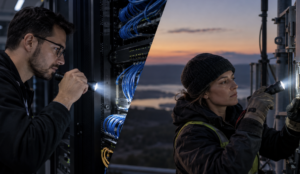
Information technology work is often associated with monitors, servers, networking hardware, cloud platforms, and software. Yet much of the work that keeps modern technology running still happens in physical spaces. IT professionals routinely find themselves behind server racks, underneath desks, inside telecommunications closets, above ceiling tiles, at remote equipment installations, and in poorly illuminated facilities.
In these environments, reliable lighting becomes more than a convenience. It can make equipment identification easier, reduce time spent searching for cables and ports, and provide dependable illumination when technicians are responding to outages or infrastructure problems.
The growing complexity of modern information technology has also expanded the environments in which IT teams operate. Technical employees may support traditional offices one day and troubleshoot networking equipment at a warehouse, manufacturing facility, data center, outdoor installation, or remote communications site the next.
That makes portable equipment increasingly important. A dependable flashlight is one of the simplest pieces of equipment an IT professional can add to a field kit, yet it can become one of the most frequently used.
Modern IT Work Extends Far Beyond the Desktop
The image of an IT professional sitting behind a computer represents only one part of the technology industry. Infrastructure teams, network engineers, telecommunications technicians, systems administrators, security professionals, and field service specialists regularly interact with physical equipment.
A network problem might require examining switches mounted inside a dark communications cabinet. A workstation problem may involve following cables underneath furniture. Data center maintenance can require reading tiny equipment labels behind racks. Field technicians may need to inspect hardware installed outdoors or inside utility areas where permanent lighting is limited.
These physical responsibilities remain important even as businesses migrate more applications to cloud computing.
The IBM overview of IT infrastructure describes the combination of hardware, software, networking components, facilities, and services required to operate an organization’s technology environment. While virtualization and cloud services have transformed infrastructure management, physical devices remain the foundation supporting networks, connectivity, storage, security, and communications.
Portable illumination therefore fits naturally into the practical side of IT operations.
Server Rooms Create Unique Visibility Challenges
Server rooms and data centers are designed primarily around equipment performance, cooling, power distribution, and accessibility rather than perfect visibility from every angle.
Even brightly illuminated facilities contain areas that are difficult to see.
The front of a server rack may be well lit while the rear contains shadows created by cables, power distribution units, equipment rails, and neighboring racks. Technicians frequently need to identify ports, serial numbers, cable labels, status indicators, and connection points positioned where overhead lighting provides little assistance.
Cisco’s extensive resources covering data center networking illustrate just how dense modern infrastructure environments can become. Switches, routers, servers, storage systems, power equipment, and structured cabling may all occupy relatively compact spaces.
A portable light allows technicians to direct illumination exactly where it is needed without relying on room lighting or attempting to reposition equipment.
This can be particularly valuable when tracing network cables. Dense bundles of Ethernet and fiber connections can make identification difficult, especially behind racks. Good illumination helps technicians read labels and visually follow cable paths while minimizing unnecessary movement around active infrastructure.
Portable Lighting Supports Faster Troubleshooting
IT troubleshooting frequently involves eliminating possible causes one at a time.
When a device becomes unreachable, technicians might inspect network connections, power cables, status lights, ports, adapters, and surrounding infrastructure. In situations involving physical equipment, visibility directly affects how easily those components can be inspected.
A compact light can illuminate ports behind computers, identify loose connections, reveal damaged cables, and make equipment labels easier to read.
For professionals assembling an IT field kit, a klarus flashlight can provide portable illumination for server rooms, network closets, workstation troubleshooting, equipment inspections, and other technology environments where overhead lighting cannot reach.
The value is straightforward. Instead of using a smartphone flashlight while simultaneously trying to work with tools or equipment, technicians can carry lighting equipment specifically intended for illumination.
That leaves the phone available for documentation, communication, remote access, authentication, technical references, or photographing equipment.
Field IT Technicians Face Even More Demanding Conditions
Field technology work creates additional challenges because technicians cannot control the environment they encounter.
A service call might involve an office building with excellent lighting. The next could involve an outdoor telecommunications enclosure, warehouse network cabinet, security system installation, construction site, utility room, or equipment location that receives almost no natural light.
The expansion of connected equipment has increased the variety of places where technology professionals work.
Internet-connected cameras, access-control systems, wireless access points, environmental sensors, industrial equipment, telecommunications hardware, and Internet of Things devices are frequently installed away from conventional office workspaces.
The National Institute of Standards and Technology maintains extensive resources covering technology, cybersecurity, networking, and connected systems, reflecting how broad the modern technology ecosystem has become.
For technicians maintaining these systems, portable equipment needs to travel easily between locations. A flashlight occupies relatively little space in a tool bag while supporting an unusually wide range of tasks.
Reliable Lighting Matters During Power Interruptions
Power failures create a particularly strong case for dedicated lighting.
When electricity fails, the people responsible for restoring technology services may simultaneously lose the lighting normally used to reach and inspect that equipment.
Backup generators and emergency lighting can help, but coverage varies considerably between buildings. Network closets, storage areas, equipment rooms, and secondary infrastructure locations may remain poorly illuminated.
During an outage, IT teams may need to inspect uninterruptible power supplies, network switches, power distribution equipment, server hardware, telecommunications equipment, and environmental systems.
The Cybersecurity and Infrastructure Security Agency emphasizes resilience and the protection of critical infrastructure across the United States. Although cybersecurity receives significant attention, operational resilience also depends on organizations being prepared to maintain and restore technology systems when disruptions occur.
Portable lighting represents a very simple layer of that preparedness.
It does not replace emergency systems, backup power, or formal disaster recovery procedures. It simply gives individual technicians another useful tool when normal conditions disappear.
IT Security Also Has a Physical Component
Cybersecurity discussions often focus on malware, ransomware, authentication, firewalls, encryption, and software vulnerabilities. Physical infrastructure remains another part of the security equation.
Servers, networking equipment, backup systems, access-control devices, surveillance equipment, and telecommunications hardware exist somewhere physically.
The NIST Cybersecurity Framework provides organizations with guidance for managing cybersecurity risks. Effective security programs typically involve understanding and protecting the systems and assets on which organizations depend.
For IT personnel, that can mean physically inspecting equipment as well as reviewing software configurations.
A technician investigating an unexpected connection may need to examine ports on a switch. Security personnel may need to inspect equipment cabinets or network devices. Infrastructure teams may need to confirm which systems are physically connected to particular circuits or network segments.
Good portable lighting makes those inspections easier without requiring technicians to move equipment unnecessarily.
Cable Management Becomes Easier With Better Visibility
Cable management remains one of the least glamorous but most important elements of infrastructure maintenance.
Poorly organized wiring can complicate troubleshooting, equipment replacement, upgrades, and documentation. Even properly labeled cable systems can be difficult to inspect when dozens or hundreds of connections occupy the same rack.
The Telecommunications Industry Association develops standards and resources covering telecommunications infrastructure and structured cabling systems. Structured approaches to cabling help create predictable technology environments, but technicians still need to identify individual components during installation and maintenance.
Portable illumination can help technicians distinguish labels, connector types, cable colors, ports, and pathways more clearly.
This becomes especially helpful behind equipment racks, under raised floors, above ceilings, or inside cabinets where lighting conditions change dramatically depending on the technician’s position.
A Flashlight Can Complement the Standard IT Tool Kit
IT tool kits vary considerably by specialty.
A desktop technician may carry screwdrivers, cable ties, adapters, USB drives, compressed air, and testing tools. Network technicians may add cable testers, crimpers, console cables, fiber tools, and labeling equipment. Field engineers may carry even more specialized diagnostic hardware.
Portable lighting complements nearly all of these tools.
For example, installing a network switch may require seeing mounting holes deep inside a cabinet. Replacing a workstation component may require looking beneath a desk. Running structured cable may require inspecting spaces above ceiling panels. Troubleshooting wireless infrastructure can require locating equipment mounted high on walls or ceilings.
Microsoft maintains extensive technical guidance through Microsoft Learn, reflecting the enormous range of tasks modern IT professionals are expected to understand. While technical knowledge remains essential, physical tools still determine how efficiently many hands-on tasks can be performed.
The most useful equipment is often the equipment that solves small problems repeatedly.
Hands-Free and Portable Lighting Can Improve Workflow
Another consideration is how lighting integrates into the technician’s workflow.
Holding a smartphone in one hand while troubleshooting with the other can quickly become awkward. IT professionals frequently need both hands available for cables, tools, equipment, laptops, or testing devices.
Dedicated lighting offers greater flexibility.
A flashlight can be positioned near equipment, held briefly while locating a component, or used to illuminate a work area before a technician begins handling hardware. Certain work environments may also allow technicians to use compatible mounting or hands-free lighting accessories depending on the equipment they carry.
This becomes particularly useful when documenting infrastructure. Technicians often photograph equipment before disconnecting cables so connections can be restored correctly. Separate illumination can improve visibility while allowing the phone camera to remain dedicated to documentation.
Durability Matters for IT Professionals Who Travel
Office technology equipment typically remains indoors, but field technicians do not always have that luxury.
Tool bags may be transported between vehicles, facilities, construction areas, warehouses, data centers, outdoor installations, and customer locations. Equipment gets dropped, bumped, exposed to dust, and subjected to temperature changes.
That makes durability an important characteristic for any frequently carried tool.
Portable lights intended for demanding environments can be more appropriate for field technicians than inexpensive household flashlights that remain in a drawer most of the year.
A professional IT kit should be designed around reliability. Technicians depend on their tools when something has already gone wrong, making equipment failure particularly inconvenient.
The Growing Physical Footprint of Digital Infrastructure
Cloud computing sometimes creates the impression that technology has become almost entirely virtual.
In reality, cloud services depend on enormous amounts of physical infrastructure.
The Google Cloud infrastructure supporting cloud computing still relies on servers, networking hardware, storage systems, data centers, power systems, and communications infrastructure. Similar physical foundations support virtually every major cloud platform.
The continuing growth of artificial intelligence, edge computing, cloud services, streaming media, connected devices, and digital commerce is increasing demand for computing infrastructure around the world.
That means physical IT work is not disappearing. It is changing.
Technicians increasingly maintain combinations of traditional networking equipment, cloud-connected hardware, edge devices, wireless infrastructure, cameras, access systems, sensors, and remotely managed equipment.
A professional may manage systems through a browser in the morning and physically inspect networking hardware later that afternoon.
Tools that bridge those two environments remain valuable.
Small Tools Can Make a Noticeable Difference in IT Operations
Technology professionals naturally focus on sophisticated equipment. Network analyzers, monitoring platforms, endpoint management systems, diagnostic software, cybersecurity tools, and remote administration platforms receive most of the attention.
Yet everyday productivity often depends on much simpler items.
Cable labels prevent confusion. Velcro straps improve wiring organization. Precision screwdrivers make equipment repairs easier. Portable chargers keep devices functioning in the field. Reliable lighting improves visibility.
None of these tools transforms an IT department on its own.
Together, however, they help technicians work more efficiently and remain prepared for unusual situations.
That is why a flashlight can earn a legitimate place beside far more advanced technology inside an IT professional’s equipment bag.
Conclusion
Modern information technology combines digital expertise with hands-on infrastructure work. Servers, switches, routers, cables, telecommunications equipment, security devices, wireless access points, and connected systems still need to be installed, inspected, maintained, and repaired by people working in physical environments.
Those environments are not always well lit.
Server racks create shadows. Network closets can be cramped. Equipment may be installed above ceilings, underneath desks, outdoors, or inside cabinets. Power failures can eliminate normal lighting precisely when technology professionals need to reach critical systems.
Portable lighting provides a straightforward solution.
For IT professionals moving between server rooms, offices, data centers, telecommunications spaces, and field locations, a dependable flashlight is not merely emergency equipment. It can become a practical everyday tool for identifying hardware, tracing connections, inspecting infrastructure, documenting equipment, and completing technical work more efficiently.
The technology industry may continue moving deeper into cloud computing, artificial intelligence, automation, and distributed infrastructure, but every digital service ultimately depends on physical systems somewhere. As long as IT professionals continue maintaining those systems, having reliable illumination available will remain surprisingly useful.