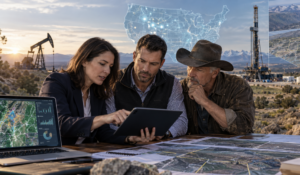
Technology has changed the way nearly every major asset is researched, measured, managed, and valued. Mineral rights are increasingly part of that transformation. What was once a field heavily dependent on paper courthouse records, geological maps, personal contacts, and time-consuming manual research is becoming more digital. Data platforms, artificial intelligence, geographic information systems, cloud computing, predictive analytics, and other information technologies are giving mineral owners, energy companies, investors, and consultants access to information that can influence how mineral assets are evaluated.
The shift is significant because mineral rights can represent substantial financial value, yet determining that value is rarely simple. Location, production history, commodity prices, lease terms, drilling activity, geology, ownership records, and future development potential can all influence an asset. Technology does not eliminate those variables. Instead, it gives professionals better ways to collect, compare, organize, and interpret them.
The broader evolution reflects what is happening throughout the technology industry. Wikipedia’s overview of information technology describes IT as encompassing technologies used to create, process, store, retrieve, and transmit information. Those capabilities are now increasingly relevant to an industry built around enormous quantities of geological, geographic, financial, and ownership information.
Mineral Rights Valuation Is Becoming More Data Driven
Mineral rights have always been closely connected to data, but the quantity and accessibility of that data have changed dramatically. A valuation may involve examining existing wells, nearby drilling activity, production records, operator activity, geological formations, lease conditions, acreage, ownership percentages, and regional energy development.
Historically, gathering all of that information could require multiple databases, courthouse visits, printed maps, telephone calls, and extensive manual research. Digital technology allows much of that information to be organized and analyzed considerably faster.
Modern data analytics platforms can combine information from numerous sources and help analysts identify relationships that might otherwise be difficult to recognize. That does not mean software can simply produce an unquestionably correct mineral rights value. Mineral assets remain highly individual, and professional judgment still matters. Technology instead strengthens the information available to the people making those judgments.
This mirrors a much larger trend across American business. CIO’s reporting on data analytics and business decision-making explains how organizations increasingly use data collection, modeling, transformation, and analysis to identify trends and improve decisions. Similar principles can be applied when professionals are trying to understand the financial potential of mineral ownership.
Artificial Intelligence Is Expanding the Analytical Toolkit
Artificial intelligence has introduced another layer of capability. AI systems are particularly useful when large quantities of information need to be compared, categorized, summarized, or evaluated for patterns.
A mineral rights analysis might involve well records, production histories, nearby transactions, legal descriptions, operator information, geological information, public filings, historical commodity prices, and other documents. Sorting through those records manually can consume significant time.
Artificial intelligence and machine learning can assist with identifying patterns across large datasets. Predictive models can also help professionals evaluate different scenarios based on historical information and changing assumptions.
IBM describes AI analytics as the use of artificial intelligence to process and interpret data, including techniques involving machine learning, natural-language processing, and data mining. IBM’s AI analytics resource notes that these technologies can help organizations analyze larger and more diverse datasets and make information easier to use for decision-making.
For mineral rights, the practical advantage is not that AI replaces experienced mineral professionals. Its value comes from helping professionals examine substantially more information while reducing some of the repetitive work involved in gathering and organizing data.
Digital Mapping Is Providing a Clearer Picture of Mineral Assets
Location is one of the most important elements affecting mineral rights. Two properties separated by a relatively short distance can have dramatically different development potential depending on geological formations, drilling activity, operator interest, infrastructure, and production results.
Geographic information systems have therefore become extremely useful within energy and natural-resource industries. Digital mapping allows layers of information to be viewed together rather than studied independently.
A map can potentially display property boundaries alongside existing wells, producing wells, permits, geological formations, pipelines, roads, drilling units, and other relevant information. That visual relationship can give analysts a clearer picture of what is happening around a particular mineral property.
Digital mapping can also make comparisons easier. Instead of reading several separate reports and attempting to mentally assemble the information, an analyst can examine how numerous factors overlap geographically.
The result is a more complete view of an asset’s surroundings, which is particularly valuable because mineral value is rarely determined by acreage alone.
Cloud Computing Is Making Mineral Information Easier to Access
The growth of cloud technology has changed where information can be stored and how quickly it can be shared. Mineral professionals no longer need every important document stored in a physical office or on an individual computer.
Cloud databases can make geological information, property records, maps, reports, transaction information, and internal analysis accessible to authorized teams in different locations.
That accessibility can make mineral transactions more efficient. Land professionals, attorneys, geologists, valuation specialists, buyers, and owners may all need different pieces of information before a transaction progresses. Digital systems make collaboration easier and can reduce delays created when documents have to be physically transferred.
The importance of reliable IT infrastructure continues to grow across industries. The National Institute of Standards and Technology’s information technology resources cover areas including cloud computing, data and informatics, cybersecurity, privacy, and digital systems. Those same technological foundations increasingly support industries that historically relied much more heavily on physical records.
Production Data Can Reveal More About Nearby Mineral Potential
Oil and gas production is rarely evaluated in isolation. What happens on nearby properties can provide useful context regarding a mineral asset.
Digital production databases allow analysts to examine how nearby wells have performed over time. They can compare initial production, production decline, operator activity, well density, and historical drilling patterns.
The information becomes particularly valuable when it is paired with geological and mapping data. A producing well several miles away does not automatically establish the value of another property, but clusters of production and development activity can help create a broader picture of an area.
Technology makes these comparisons far easier than they were when information had to be collected from numerous physical records.
Better access to information is also changing expectations among property owners. Owners can research operators, view publicly available production records, follow commodity markets, and learn more about regional drilling activity before making financial decisions.
Energy Technology Investment Is Connecting IT More Closely With Oil and Gas
The overlap between technology and energy is becoming increasingly visible at the corporate level. Energy businesses are investing heavily in artificial intelligence, computing infrastructure, automation, and digital analysis.
Reuters recently reported on SLB’s expanded partnership with Nvidia to develop AI infrastructure and models specifically for the energy sector. The effort is designed in part to process large amounts of geological, production, and infrastructure information. Reuters’ coverage of AI infrastructure for the energy industry demonstrates how closely advanced computing and traditional energy operations are beginning to intersect.
This matters to mineral owners because technologies developed for large energy companies eventually influence the wider ecosystem. Better geological analysis, faster processing of production information, improved modeling, and more sophisticated digital databases can all affect how energy opportunities are discovered and evaluated.
Technology development in the energy sector is therefore not limited to drilling equipment. Some of the industry’s most consequential innovations are happening inside data centers and software platforms.
AI’s Expanding Energy Demand Adds Another Technology Connection
There is another connection between IT and mineral assets that goes beyond valuation software. Artificial intelligence itself requires enormous computing infrastructure, and that infrastructure requires energy.
Data centers powering cloud computing and AI applications are consuming increasingly large amounts of electricity. WIRED has reported on the rapid growth of energy demand associated with AI and data-center infrastructure. WIRED’s reporting on AI and data-center power demand highlights how expanding computing requirements are creating significant new electricity needs.
That trend could have indirect consequences for American energy markets. Increased power demand may affect investment in natural gas generation, transmission infrastructure, renewable energy, nuclear power, and other energy resources.
Technology companies and energy companies that once occupied largely separate economic worlds are becoming increasingly connected. AI needs energy, energy companies need data, and both industries increasingly depend upon sophisticated digital infrastructure.
TechCrunch has also examined the relationship between expanding data-center demand and future energy development. TechCrunch’s coverage of data centers and changing energy demand illustrates how computing growth is becoming part of the larger discussion about America’s future energy mix.
For mineral owners, these developments are worth watching because long-term energy demand can influence exploration, infrastructure investment, commodity markets, and development interest.
Better Information Can Help Mineral Owners Make More Informed Decisions
Technology is also changing the balance of information available during mineral transactions.
Mineral owners traditionally faced a significant information disadvantage when dealing with companies that maintained extensive geological, production, and market databases. Public databases, online mapping systems, digital research services, and professional analytical tools are narrowing some of that gap.
An owner considering Selling Mineral Rights can now have access to substantially more information before evaluating an offer or deciding whether a transaction fits his or her financial goals.
Information alone does not determine whether an offer should be accepted. Mineral rights can involve complicated title issues, taxes, estate planning, legal considerations, market conditions, and differing expectations about future drilling.
The important development is that technology can support a more informed conversation. An owner can arrive with a better understanding of nearby wells, regional development, ownership issues, commodity markets, and the factors that may be influencing buyer interest.
Cybersecurity and Data Integrity Are Becoming More Important
The digitization of mineral records also creates responsibilities.
Valuation models are only as dependable as the information entering them. Incorrect ownership information, duplicate records, inaccurate production data, mapping errors, or compromised files can lead to poor conclusions.
Security matters as well. Mineral transactions may involve ownership records, contracts, payment information, legal documents, tax information, and other sensitive material.
As more of that information is stored and transmitted electronically, companies need strong data-management practices. The National Cybersecurity Center of Excellence emphasizes confidentiality, integrity, and availability as central elements of data security. Those principles apply to mineral companies just as they apply to financial institutions, technology businesses, and other organizations handling valuable information.
Reliable technology therefore involves more than adopting sophisticated software. Businesses must also know where information came from, whether it is accurate, who can access it, and how it is protected.
Human Expertise Still Matters in a Technology-Driven Market
The rapid expansion of AI has sometimes created the impression that software will replace professional judgment. Mineral valuation demonstrates why that assumption can be misleading.
A computer can process production records rapidly. It can identify nearby wells, organize transaction data, calculate historical averages, and model possible outcomes. It cannot guarantee that a particular operator will drill a property, predict commodity prices with certainty, resolve every ownership dispute, or know exactly what a buyer will be willing to pay months from now.
The strongest approach combines technology with knowledgeable interpretation.
CIO has discussed the importance of building strong analytics capabilities rather than assuming artificial intelligence alone will automatically produce useful answers. CIO’s analysis of AI and analytics capabilities reinforces a principle that applies well beyond corporate IT departments: technology is most useful when accurate information, sound processes, and experienced people work together.
For mineral rights, that means digital tools can improve research and analysis while experienced professionals continue to interpret what those findings mean in a real transaction.
Technology Could Make Mineral Markets More Transparent
One of the most interesting long-term possibilities is greater transparency.
Mineral rights are not traded on a centralized public exchange in the same way publicly traded stocks are. Individual properties differ, transactions can remain private, and the value of one mineral interest may not closely match another.
Technology cannot completely eliminate those differences, but larger databases and better analytical tools may make market comparisons more useful.
As additional transaction information becomes digitized and more public records become searchable, analysts may be able to evaluate broader groups of comparable assets. Machine learning could help identify relationships between geology, production, transaction activity, location, commodity prices, and buyer behavior.
That does not necessarily create a single market price. Instead, it can create a stronger informational foundation for valuation.
The mineral market may always require specialized knowledge because every property has its own characteristics. What is changing is the amount of information that specialists can examine before reaching a conclusion.
Conclusion
The future of mineral rights value is becoming closely connected to the future of information technology. Digital maps can provide a clearer picture of properties and nearby drilling. Cloud systems can make records easier to organize and share. Artificial intelligence can analyze enormous collections of information. Production databases can reveal regional trends. Predictive analytics can help professionals study possible outcomes, while stronger cybersecurity practices can protect the increasingly valuable information behind mineral transactions.
At the same time, America’s technology boom is creating a second connection between IT and mineral resources. AI systems and data centers require tremendous quantities of power, linking the expansion of digital infrastructure with the future of the energy industry itself.
Technology will not transform mineral rights into simple assets with predictable prices. Geology, ownership, drilling activity, commodity markets, contracts, and future development will continue to create uncertainty. What technology can do is give owners and professionals a clearer window into those factors.
Across America, that represents a significant shift. Mineral rights valuation is moving away from a world dominated by scattered records and isolated information toward one built around connected data, advanced analytics, digital mapping, and increasingly sophisticated computing. The minerals remain underground, but much of the intelligence used to understand their potential value is moving rapidly into the digital world.